publications
Research publications, preprints and theses by me (Florian Meier).
Papers
2026
- Rep. Prog. Phys.
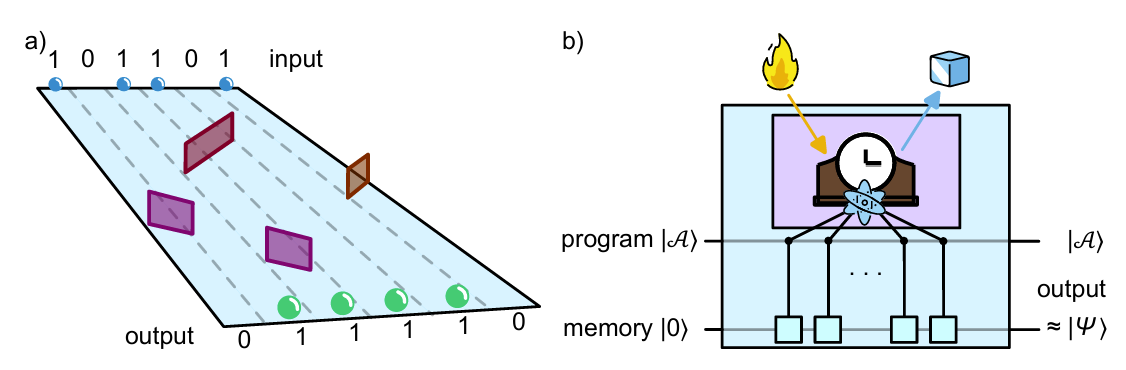 Autonomous Quantum Processing Unit: An Autonomous Thermal Computing Machine and its Physical LimitationsFlorian Meier, Marcus Huber, Paul Erker, and 1 more authorReports on Progress in Physics, 2026
Computation is an input-output process, where a program encoding a problem to be solved is inserted into a machine that outputs a solution. Quantum computation conventionally relies on classical, external control outside the quantum computer to execute a program, obscuring computational and thermodynamic resources required. To understand the fundamental limits of computation, however, it is pivotal to work with a fully self-contained description of a quantum computation, modeling the resources on the same footing as the computation itself. By developing a framework that we dub the autonomous Quantum Processing Unit (aQPU) we model quantum computation in the framework of autonomous thermal machines. Consisting of an internal quantum timekeeping mechanism, instruction register and memory system the aQPU allows investigating relationships between thermodynamic cost, complexity, speed and fidelity of a desired quantum computation.
- arXiv
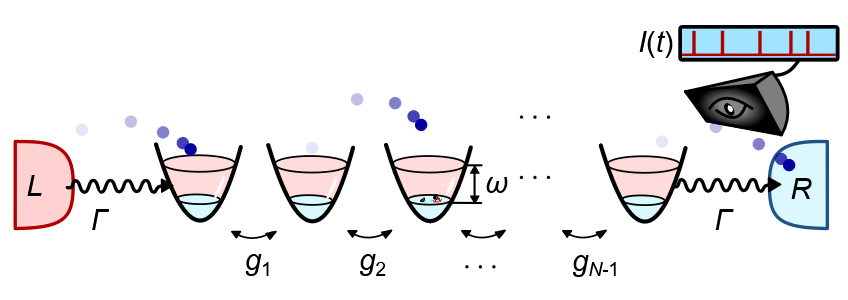 Exponential gain in clock precision using quantum correlated ticksFlorian Meier, Yuri Minoguchi, Gianmichele Blasi, and 2 more authorsarXiv preprint arXiv:2601.10785, 2026Under review
Creating precise timing devices at ultra-short time scales is not just an important technological challenge, but confronts us with foundational questions about timekeeping’s ultimate precision limits. Research on clocks has either focused on long-term stability using an oscillator stabilized by a level transition, limiting precision at short timescales, or on making individual stochastic ticks as precise as possible. Here, we prove the viability of a conceptually different avenue: the autonomous self-correction of consecutive ticks by quantum correlations. This provides a new paradigm that integrates the advantages and insights from quantum transport theory to operate clocks at ultra-short timescales. We fully solve a model of coupled quantum systems and show how the emergent Pauli exclusion principle correlates the clock at the quantum level yielding an exponential advantage in precision. We furthermore demonstrate through simulations with realistic imperfections that this remarkable gain in precision remains stable providing a roadmap for implementation with contemporary quantum technologies.
- PhD Thesis
2025
- Phys. Rev. Lett.
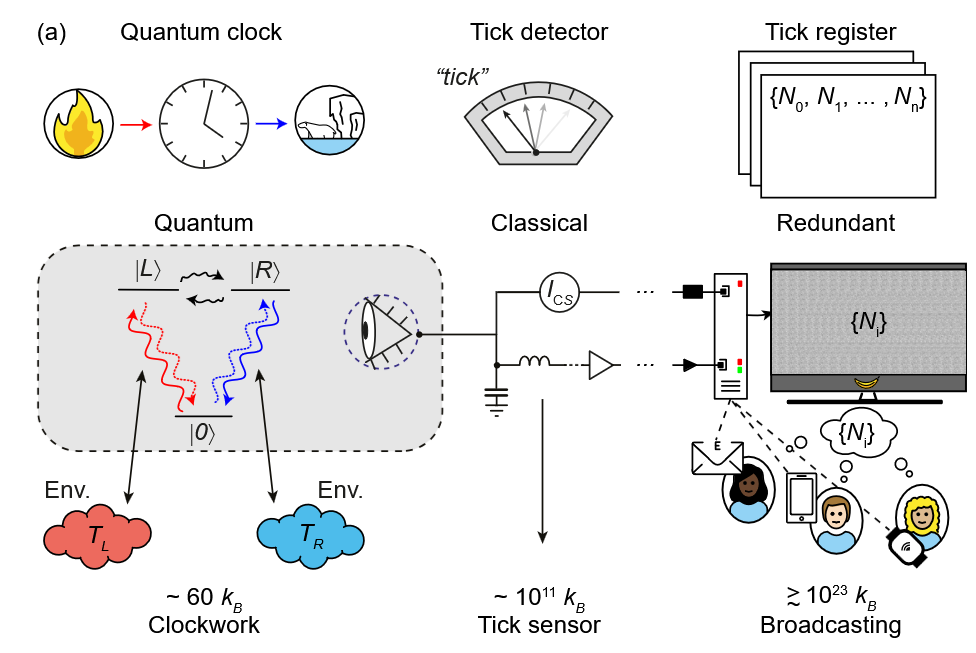 Entropic costs of extracting classical ticks from a quantum clockVivek Wadhia, Florian Meier, Federico Fedele, and 12 more authorsPhysical Review Letters, 2025
We experimentally realize a quantum clock by using a charge sensor to count charges tunneling through a double quantum dot (DQD). Individual tunneling events are used as the clock’s ticks. We quantify the clock’s precision while measuring the power dissipated by the DQD and, separately, the charge sensor in both direct-current and radio-frequency readout modes. This allows us to probe the thermodynamic cost of creating ticks microscopically and recording them macroscopically. Our experiment is the first to explore the interplay between the entropy produced by a microscopic clockwork and its macroscopic measurement apparatus. We show that the latter contribution not only dwarfs the former but also unlocks greatly increased precision, because the measurement record can be exploited to optimally estimate time even when the DQD is at equilibrium. Our results suggest that the entropy produced by the amplification and measurement of a clock’s ticks, which has often been ignored in the literature, is the most important and fundamental thermodynamic cost of timekeeping at the quantum scale.
- Nat. Phys.
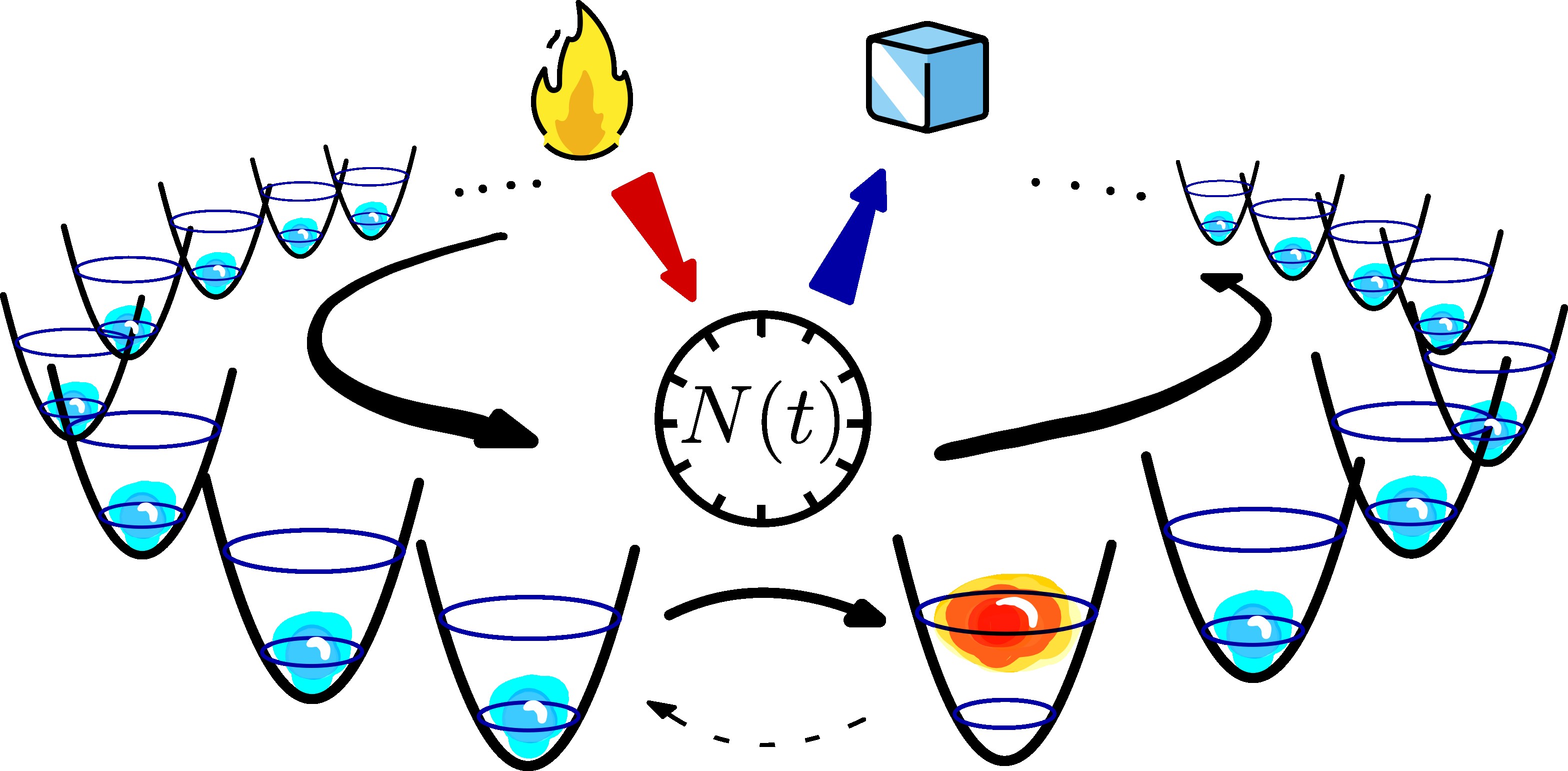 Precision is not limited by the second law of thermodynamicsFlorian Meier, Yuri Minoguchi, Simon Sundelin, and 4 more authorsNature Physics, 2025
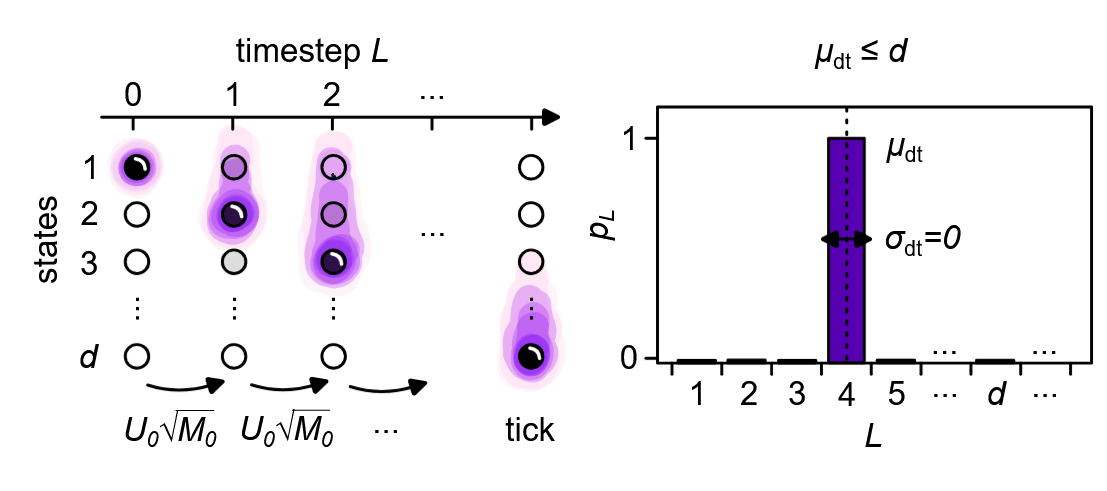
Physical devices operating out of equilibrium are inherently affected by thermal fluctuations, limiting their operational precision. This issue is pronounced at microscopic and especially quantum scales and can only be mitigated by incurring additional entropy dissipation. Understanding this constraint is crucial for both fundamental physics and technological design. For instance, clocks are inherently governed by the second law of thermodynamics and need a thermodynamic flux towards equilibrium to measure time, which results in a minimum entropy dissipation per clock tick. Classical and quantum models and experiments often show a linear relationship between precision and dissipation, but the ultimate bounds on this relationship are unknown. Our theoretical discovery presents an extensible quantum many-body system that achieves clock precision scaling exponentially with entropy dissipation. This finding demonstrates that coherent quantum dynamics can surpass the traditional thermodynamic precision limits, potentially guiding the development of future high-precision, low-dissipation quantum devices.
- PRX Quantum
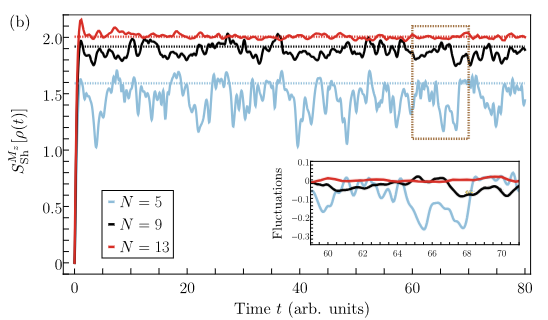 Emergence of a second law of thermodynamics in isolated quantum systemsFlorian Meier, Tom Rivlin, Tiago Debarba, and 3 more authorsPRX Quantum, 2025
The second law of thermodynamics states that the entropy of an isolated system can only increase over time. This appears to conflict with the reversible evolution of isolated quantum systems under the Schrödinger equation, which preserves the von Neumann entropy. Nonetheless, one finds that with respect to many observables, expectation values approach a fixed value – their equilibrium value. This ultimately raises the question: in what sense does the entropy of an isolated quantum system increase over time? For classical systems, one introduces the assumption of a low entropy initial state along with the concept of ignorance about the microscopic details of the physical system, leading to a statistical interpretation of the second law. By considering the observables through which we examine quantum systems, both these assumptions can be incorporated, building upon recent studies of the equilibration on average of observables. While the statistical behavior of observable expectation values is well-established, a quantitative connection to entropy increase has been lacking so far. In deriving novel bounds for the equilibration of observables, and considering the entropy of the system relative to observables, we recover a variant of the second law: the entropy with respect to a given observable tends towards its equilibrium value in the course of the system’s unitary evolution. These results also support recent findings which question the necessity of non-integrability for equilibration in quantum systems. We further illustrate our bounds using numerical results from the paradigmatic example of a quantum Ising model on a chain of spins. There, we observe entropy increasing up to equilibrium values, as well as fluctuations which expose the underlying reversible evolution in accordance with the derived bounds.
- Phys. Rev. A
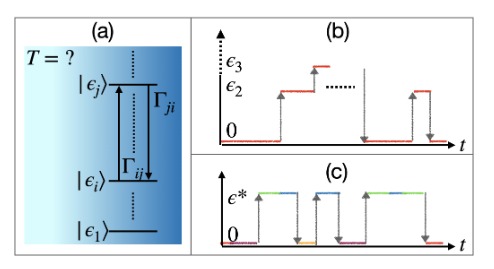 Optimal limits of continuously monitored thermometers and their Hamiltonian structureMohammad Mehboudi, Florian Meier, Marcus Huber, and 1 more authorPhysical Review A, 2025
We investigate the fundamental and practical precision limits of thermometry in bosonic and fermionic environments by coupling an N-level probe to them and continuously monitoring it. Our findings show that the ultimate precision limit, quantified by the Fisher information, scales linearly with N, offering an exponential improvement over equilibrium thermometry, where the scaling is only \log^2 N. For a fixed Hamiltonian structure, we develop a maximum likelihood estimation strategy that maps the observed continuously monitored trajectories of the probe into temperature estimates with minimal error. By optimizing over all possible Hamiltonian structures, we discover that the optimal configuration is an effective two-level system, with both levels exhibiting degeneracy that increases with N, a stark contrast to equilibrium thermometry, where the ground state remains non-degenerate. Our results have practical implications. First, continuous monitoring is experimentally feasible on several platforms and accounts for the preparation time of the probe, which is often overlooked in other approaches such as prepare-and-reset. Second, the linear scaling is robust against deviations from the effective two-level structure of the optimal Hamiltonian. Additionally, this robustness extends to cases of initial ignorance about the temperature. Thus, in global estimation problems, the linear scaling remains intact even without adaptive strategies.
- Phys. Rev. X
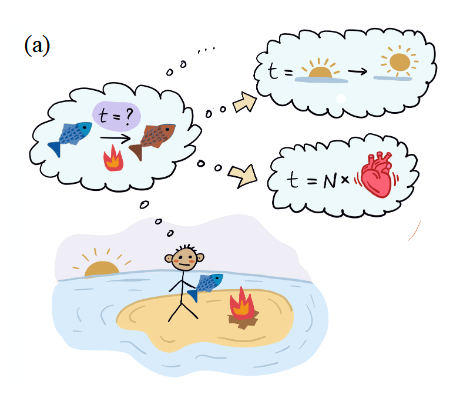 Optimal time estimation and the clock uncertainty relation for stochastic processesKacper Prech, Gabriel T. Landi, Florian Meier, and 4 more authorsPhysical Review X, 2025
Time estimation is a fundamental task that underpins precision measurement, global navigation systems, financial markets, and the organisation of everyday life. Many biological processes also depend on time estimation by nanoscale clocks, whose performance can be significantly impacted by random fluctuations. In this work, we formulate the problem of optimal time estimation for Markovian stochastic processes, and present its general solution in the asymptotic (long-time) limit. Specifically, we obtain a tight upper bound on the precision of any time estimate constructed from sustained observations of a classical, Markovian jump process. This bound is controlled by the mean residual time, i.e. the expected wait before the first jump is observed. As a consequence, we obtain a universal bound on the signal-to-noise ratio of arbitrary currents and counting observables in the steady state. This bound is similar in spirit to the kinetic uncertainty relation but provably tighter, and we explicitly construct the counting observables that saturate it. Our results establish ultimate precision limits for an important class of observables in non-equilibrium systems, and demonstrate that the mean residual time, not the dynamical activity, is the measure of freneticity that tightly constrains fluctuations far from equilibrium.
- PRX Energy
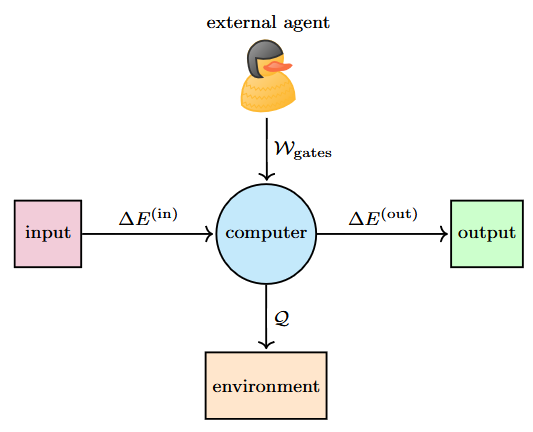 Energy-Consumption Advantage of Quantum ComputationFlorian Meier and Hayata YamasakiPRX Energy, 2025
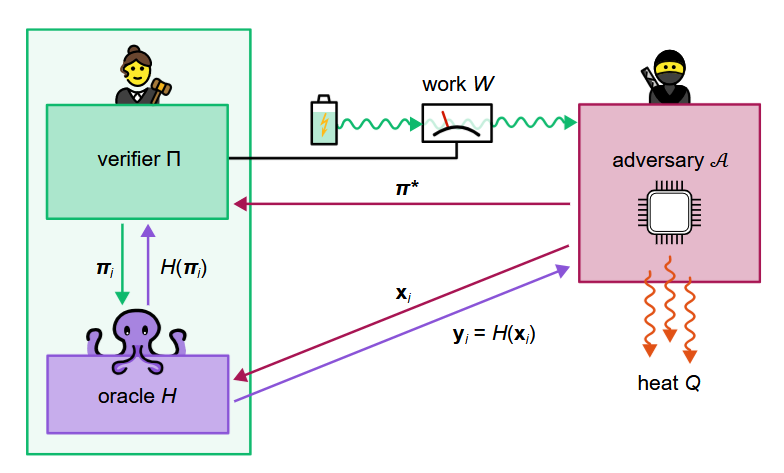
Energy consumption in solving computational problems has been gaining growing attention as one of the key performance measures for computers. Quantum computation is known to offer advantages over classical computation in terms of various computational resources; however, proving its energy-consumption advantage has been challenging due to the lack of a theoretical foundation linking the physical concept of energy with the computer-scientific notion of complexity for quantum computation. To bridge this gap, we introduce a general framework for studying the energy consumption of quantum and classical computation, based on a computational model conventionally used for studying query complexity in computational complexity theory. Within this framework, we derive an upper bound for the achievable energy consumption of quantum computation, accounting for imperfections in implementation appearing in practice. As part of this analysis, we construct a protocol for Landauer erasure with finite precision in a finite number of steps, which constitutes a contribution of independent interest. Additionally, we develop techniques for proving a nonzero lower bound of energy consumption of classical computation, based on the energy-conservation law and Landauer’s principle. Using these general bounds, we rigorously prove that quantum computation achieves an exponential energy-consumption advantage over classical computation for solving a paradigmatic computational problem – Simon’s problem. Furthermore, we propose explicit criteria for experimentally demonstrating this energy-consumption advantage of quantum computation, analogous to the experimental demonstrations of quantum computational supremacy. These results establish a foundational framework and techniques to explore the energy consumption of computation, opening an alternative way to study the advantages of quantum computation.
2023
- Phys. Rev. Lett.
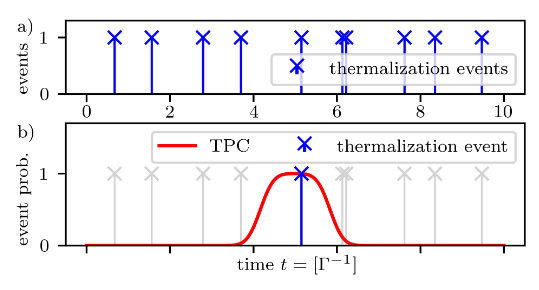 Fundamental accuracy-resolution trade-off for timekeeping devicesFlorian Meier, Emanuel Schwarzhans, Paul Erker, and 1 more authorPhysical Review Letters, 2023
From a thermodynamic point of view, all clocks are driven by irreversible processes. Additionally, one can use oscillatory systems to temporally modulate the thermodynamic flux towards equilibrium. Focusing on the most elementary thermalization events, this modulation can be thought of as a temporal probability concentration for these events. There are two fundamental factors limiting the performance of clocks: On the one level, the inevitable drifts of the oscillatory system, which are addressed by finding stable atomic or nuclear transitions that lead to astounding precision of today’s clocks. On the other level, there is the intrinsically stochastic nature of the irreversible events upon which the clock’s operation is based. This becomes relevant when seeking to maximize a clock’s resolution at high accuracy, which is ultimately limited by the number of such stochastic events per reference time unit. We address this essential trade-off between clock accuracy and resolution, proving a universal bound for all clocks whose elementary thermalization events are memoryless.
- Phys. Rev. Lett.
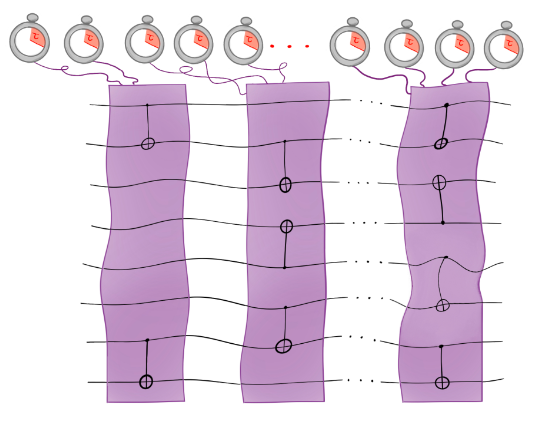 The Impact of Imperfect Timekeeping on Quantum ControlJake Xuereb, Florian Meier, Paul Erker, and 2 more authorsPhysical Review Letters, 2023
In order to unitarily evolve a quantum system, an agent requires knowledge of time, a parameter which no physical clock can ever perfectly characterise. In this letter, we study how limitations on acquiring knowledge of time impact controlled quantum operations in different paradigms. We show that the quality of timekeeping an agent has access to limits the circuit complexity they are able to achieve within circuit-based quantum computation. We do this by deriving an upper bound on the average gate fidelity achievable under imperfect timekeeping for a general class of random circuits. Another area where quantum control is relevant is quantum thermodynamics. In that context, we show that cooling a qubit can be achieved using a timer of arbitrary quality for control: timekeeping error only impacts the rate of cooling and not the achievable temperature. Our analysis combines techniques from the study of autonomous quantum clocks and the theory of quantum channels to understand the effect of imperfect timekeeping on controlled quantum dynamics.
2022
- Phys. Rev. A
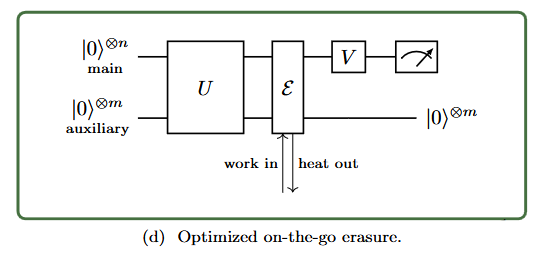 Thermodynamic optimization of quantum algorithms: On-the-go erasure of qubit registersFlorian Meier and Lídia RioPhysical Review A, 2022
We consider two bottlenecks in quantum computing: limited memory size and noise caused by heat dissipation. Trying to optimize both, we investigate "on-the-go erasure" of quantum registers that are no longer needed for a given algorithm: freeing up auxiliary qubits as they stop being useful would facilitate the parallelization of computations. We study the minimal thermodynamic cost of erasure in these scenarios, applying results on the Landauer erasure of entangled quantum registers. For the class of algorithms solving the Abelian hidden subgroup problem, we find optimal on-the-go erasure protocols. We conclude that there is a trade-off: if we have enough partial information about a problem to build efficient on-the-go erasure, we can use it to instead simplify the algorithm, so that fewer qubits are needed to run the computation in the first place. We provide explicit protocols for these two approaches.
- Master’s ThesisPerformance limits of decay clocks: Fundamental accuracy and resolution limits of quantum clocks with exponential ticking mechanismFlorian MeierETH Zürich, 2022