I am currently still writing this page. Feel free check out the papers below in the meantime, and try to come back at a later point.
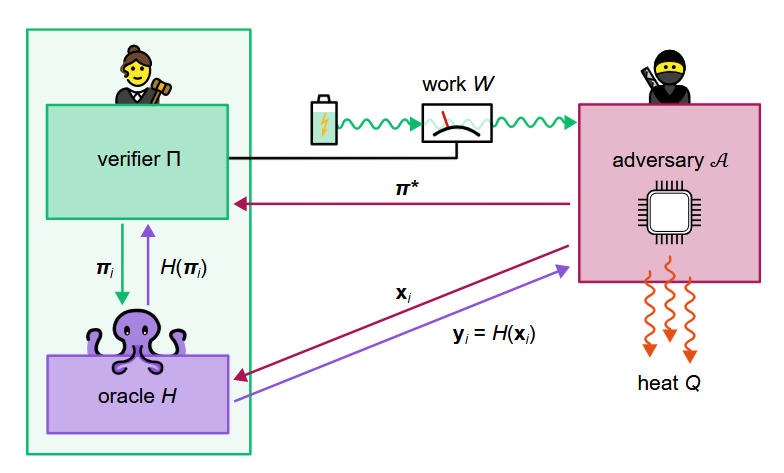
Thermodynamic verification of quantumness. The adversary has to solve a computational problem whose solution is then checked by the verifier. The problem should be set up in such a way that any classical adversary _provably_ has to expend an unphysical amount of energy to arrive at the correct solution, whereas a quantum adversary can in principle solve the problem with modest energy consumption. A correct proof with low energy consumption thus proves the quantumness of an adversary.
Selection of relevant works
2026
arXiv
Thermodynamic Proof of Quantumness without Structure
Demonstrating that a machine performs genuinely quantum operations is a central challenge in quantum information processing. Existing proofs of quantumness typically rely on computational tasks that are infeasible for classical machines under assumptions such as computational hardness, or explicit bounds on classical runtime, memory, or oracle queries. Here we introduce an alternative paradigm: a thermodynamic proof of quantumness based on energy consumption. Using the search problem of Yamakawa and Zhandry with a structureless uniformly random oracle, we show that any classical machine solving the task with constant success probability must generate entropy that grows exponentially with the security parameter. By Landauer’s principle, this implies an exponential lower bound on heat dissipation and hence on the energy consumption of any cyclic classical implementation. In contrast, the corresponding quantum prover solves the task with polynomial query and gate complexity, giving polynomial energy consumption under standard assumptions for quantum implementations. Thus, in the random-oracle setting, sufficiently low energy consumption in a successful implementation certifies quantumness through a macroscopic thermodynamic observation of energy consumption.
2025
PRX Energy
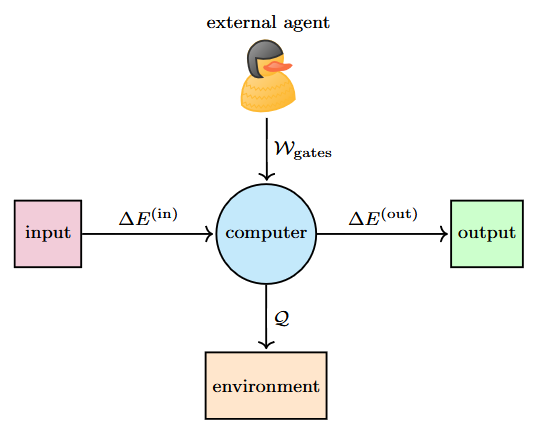
Energy-Consumption Advantage of Quantum Computation
Energy consumption in solving computational problems has been gaining growing attention as one of the key performance measures for computers. Quantum computation is known to offer advantages over classical computation in terms of various computational resources; however, proving its energy-consumption advantage has been challenging due to the lack of a theoretical foundation linking the physical concept of energy with the computer-scientific notion of complexity for quantum computation. To bridge this gap, we introduce a general framework for studying the energy consumption of quantum and classical computation, based on a computational model conventionally used for studying query complexity in computational complexity theory. Within this framework, we derive an upper bound for the achievable energy consumption of quantum computation, accounting for imperfections in implementation appearing in practice. As part of this analysis, we construct a protocol for Landauer erasure with finite precision in a finite number of steps, which constitutes a contribution of independent interest. Additionally, we develop techniques for proving a nonzero lower bound of energy consumption of classical computation, based on the energy-conservation law and Landauer’s principle. Using these general bounds, we rigorously prove that quantum computation achieves an exponential energy-consumption advantage over classical computation for solving a paradigmatic computational problem – Simon’s problem. Furthermore, we propose explicit criteria for experimentally demonstrating this energy-consumption advantage of quantum computation, analogous to the experimental demonstrations of quantum computational supremacy. These results establish a foundational framework and techniques to explore the energy consumption of computation, opening an alternative way to study the advantages of quantum computation.