The irreversible passage of time is an elementary part of our everyday experience, and yet we fail to understand it rigorously. Despite this gap in human understanding of time, scientific advances have led to remarkable technological progress. Today’s state-of-the-art atomic and optical clocks keep time with a precision that would cause them to lose less than a second over the entire age of the current universe. This raises one of the key ‘pragmatic’ questions in this regard: what limitations does nature impose on the possible precision of a clock? How much further can technology go?
I personally believe there is much more to clocks than this question suggests. Clocks prompt us to think about what time or what the passage of time really is. While I doubt that understanding can ever be truly conclusive, I believe that there are still many lessons to be learned. Lessons that, step by step, may eventually lead us to understand what a clock really is and how precise it can be.
Our starting point
Pragmatically, we may say that clocks are physical systems that tell the passage of time. This, of course, presumes there is a well-defined notion of a passage of time, such as the irreversible equilibration of physical systems to their thermal equilibrium. In fact, equilibration itself, like the cooling of a cup of coffee to room temperature, can be used to tell time. As a clock, this may not be very practical, but it nicely illustrates the variety of systems that can function as clocks.
What is a good clock?
Good clocks are usually not based on cooling coffee; instead, they are precisely engineered systems that harness the thermodynamic flow towards equilibrium in just the right way to create a regularly ticking system (see the examples in the figure below). How good a clock is is ultimately given by how reliably it can track the passage of time. For the sake of simplicity, this can be quantified using two identical clocks and counting the average number of ticks it takes for their tick counts to differ by some amount, say, two ticks.
Everyday examples of clocks. From left to right, in increasing precision and resource cost: carbon-dating clock, pendulum clock, and an atomic clock.
The resource cost of timekeeping
It turns out that precision comes at a price, and a clock can not keep time arbitrarily precisely without paying for it. The price for keeping time is non-equilibrium. Without that, that is, at thermal equilibrium, a clock is equally likely to tick forward as it is to tick backward. In other words: clocks need thermodynamic irreversibility to tick (forward), and at thermal equilibrium, this ticking stops. The story is of course more nuanced than this, and part of my work is precisely on this topic.
What I am working on
To give an overview of the topics I have been working on (and am still working on):
Thermodynamics of quantum and classical clocks? Is there even a fundamental difference?
Does a clock tick when no one looks?
Timekeeping as a special case of the quantum measurement problem.
How do atomic clocks relate to elementary quantum clocks?
If time and clocks are fascinating topics to you as well, please do not hesitate to reach out through the email given on this subpage. There is also very good literature I am happy to recommend on this topic.
For a talk I gave on this topic many years ago (ok, not so many years ago), see this YouTube Video from the Time in Quantum Theory (TiQT) 2023 in Westport, Ireland.
Selection of relevant works
2026
arXiv
Exponential gain in clock precision using quantum correlated ticks
Florian Meier, Yuri Minoguchi, Gianmichele Blasi, and 2 more authors
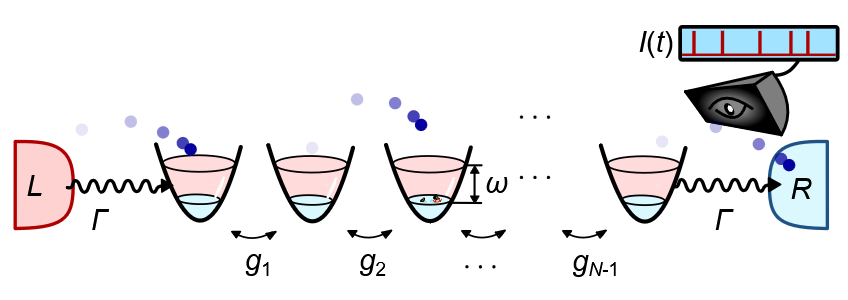
Creating precise timing devices at ultra-short time scales is not just an important technological challenge, but confronts us with foundational questions about timekeeping’s ultimate precision limits. Research on clocks has either focused on long-term stability using an oscillator stabilized by a level transition, limiting precision at short timescales, or on making individual stochastic ticks as precise as possible. Here, we prove the viability of a conceptually different avenue: the autonomous self-correction of consecutive ticks by quantum correlations. This provides a new paradigm that integrates the advantages and insights from quantum transport theory to operate clocks at ultra-short timescales. We fully solve a model of coupled quantum systems and show how the emergent Pauli exclusion principle correlates the clock at the quantum level yielding an exponential advantage in precision. We furthermore demonstrate through simulations with realistic imperfections that this remarkable gain in precision remains stable providing a roadmap for implementation with contemporary quantum technologies.
2025
Nat. Phys.
Precision is not limited by the second law of thermodynamics
Florian Meier, Yuri Minoguchi, Simon Sundelin, and 4 more authors
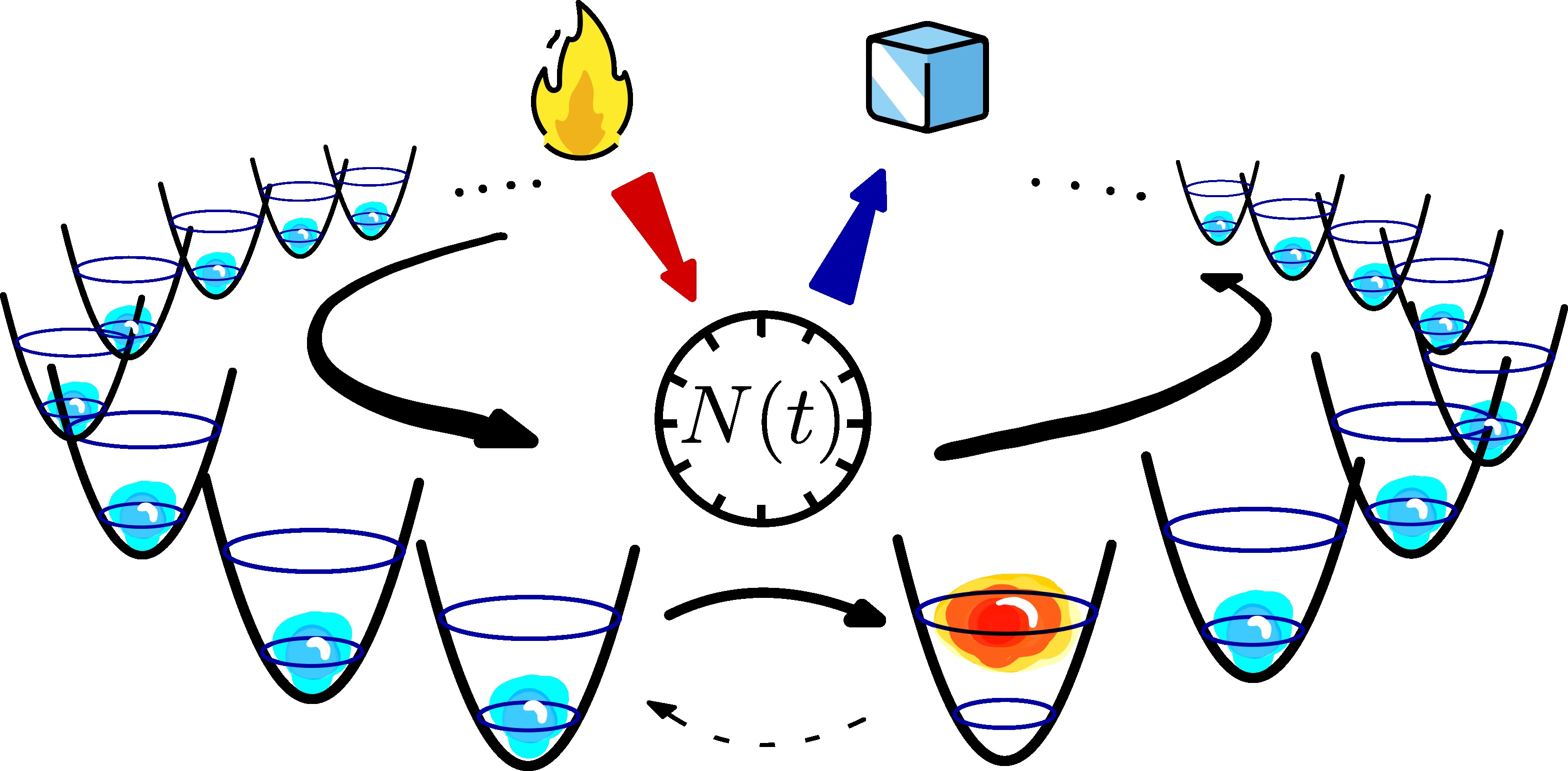
Physical devices operating out of equilibrium are inherently affected by thermal fluctuations, limiting their operational precision. This issue is pronounced at microscopic and especially quantum scales and can only be mitigated by incurring additional entropy dissipation. Understanding this constraint is crucial for both fundamental physics and technological design. For instance, clocks are inherently governed by the second law of thermodynamics and need a thermodynamic flux towards equilibrium to measure time, which results in a minimum entropy dissipation per clock tick. Classical and quantum models and experiments often show a linear relationship between precision and dissipation, but the ultimate bounds on this relationship are unknown. Our theoretical discovery presents an extensible quantum many-body system that achieves clock precision scaling exponentially with entropy dissipation. This finding demonstrates that coherent quantum dynamics can surpass the traditional thermodynamic precision limits, potentially guiding the development of future high-precision, low-dissipation quantum devices.
Phys. Rev. Lett.
Entropic costs of extracting classical ticks from a quantum clock
Vivek Wadhia, Florian Meier, Federico Fedele, and 12 more authors
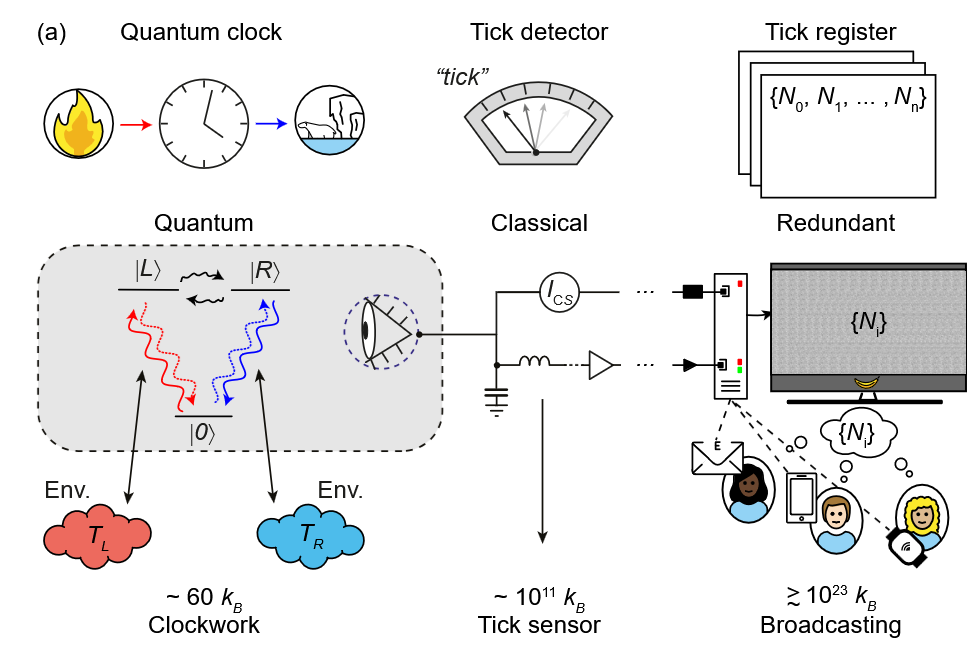
We experimentally realize a quantum clock by using a charge sensor to count charges tunneling through a double quantum dot (DQD). Individual tunneling events are used as the clock’s ticks. We quantify the clock’s precision while measuring the power dissipated by the DQD and, separately, the charge sensor in both direct-current and radio-frequency readout modes. This allows us to probe the thermodynamic cost of creating ticks microscopically and recording them macroscopically. Our experiment is the first to explore the interplay between the entropy produced by a microscopic clockwork and its macroscopic measurement apparatus. We show that the latter contribution not only dwarfs the former but also unlocks greatly increased precision, because the measurement record can be exploited to optimally estimate time even when the DQD is at equilibrium. Our results suggest that the entropy produced by the amplification and measurement of a clock’s ticks, which has often been ignored in the literature, is the most important and fundamental thermodynamic cost of timekeeping at the quantum scale.